


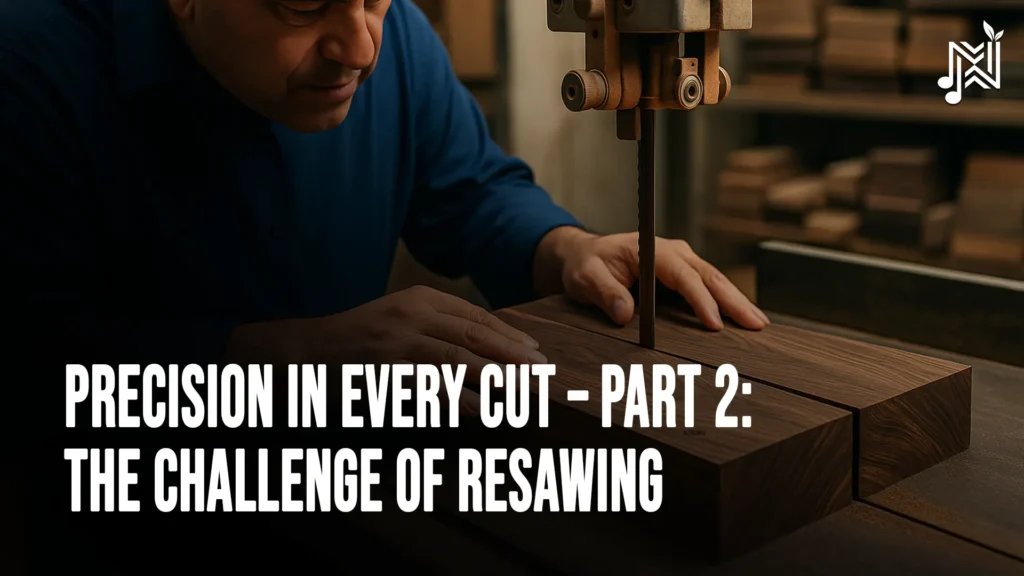
Introduction: Why Resawing Is Never Simple
If there is one truth every luthier learns quickly, it is that resawing is far from straightforward. From the outside, it looks like nothing more than slicing a board into thinner sheets. In reality, the outcome depends on a hundred small factors: horsepower, blade tension, feed rate, vibration, density, and even the mood of the wood itself.
For years I fought with these challenges. Sometimes the cuts came out clean, other times they were marred by waves, deflection, or chatter. The difference was rarely obvious until you looked closely. That is when I realized resawing is less about brute force and more about subtle control.
Why Machines Alone Are Not Enough
One of the most surprising lessons was that there is no machine on the market built specifically for the demands of tonewood. Commercial resaws are designed for lumber mills, not for luthiers slicing Cocobolo, Ebony, or Brazilian Rosewood into delicate guitar sets. Out of the box, every machine requires modification. Without adjustments, the results simply do not meet the standard needed for rare and valuable wood.
I once saw a beautiful horizontal resaw demonstrated at a trade show in Las Vegas. It worked wonderfully, but it cost nearly $100,000. That was out of reach. So instead I purchased a machine secondhand for about $10,000 and began adapting it myself. Piece by piece, I made it fit for purpose.
That is part of the story of this machine. It was never about buying perfection. It was about creating it.
Power, Stability, and Control
The foundation of a good cut is power. If the blade is not driven with steady force, the wood pushes back, and the blade begins to wander. I like to compare it to a locomotive: the smoother and stronger the push, the cleaner the cut. Weak machines produce hesitation, and hesitation translates directly into wasted wood.
The orientation also matters. Some builders swear by vertical resaws, but in my experience horizontal cutting offers more control when dealing with dense hardwoods. Softwoods like Spruce tops are one thing, but Cocobolo, African Blackwood, or oxidized Brazilian Rosewood are another matter entirely. These woods are so dense they can feel like stone. Horizontal cutting gives me the confidence to keep the blade steady without fighting against gravity.
The Battle Against Vibration and Deflection
Even with enough power, another enemy lurks: vibration. As the blade moves, it naturally wants to flex. Every flex, no matter how small, creates a wave in the cut. Over the length of a billet, that wave adds up. Instead of a clean surface, you end up with ripples. Those ripples mean more sanding, more waste, and often the loss of an entire set.
The solution came through rethinking the pressure system. Standard resaws rely on narrow rollers to press the wood before and after the blade. That might work for thicker lumber, but when you are cutting thin sheets, it allows too much vibration. I redesigned the system so the billet is pressed firmly across six to nine inches of width. With that stability, vibration is minimized and the blade is free to cut cleanly.
The difference is visible the moment the wood comes off the machine. Flat, smooth, consistent.
The Precision of Thin Cuts
Over time, I refined the process to the point where I could reliably cut stock at 0.17 inches thick. After sanding, those slices finish at 0.125 inches—exactly one eighth of an inch. That margin is tiny, but it is critical. It means less waste, more sets, and the ability to get the most out of each billet.
There have been times when I pushed the machine further, testing limits on extremely rare woods. I remember working on spider-web figured Brazilian Rosewood, material so rare it is almost mythical. Each billet was expected to yield four sets, but a single mistake could have reduced it to three. The loss of one set would have meant thousands of dollars gone. With careful setup, sharp blades, and precise guides, we preserved every set.
Moments like that remind me why the details matter. Every blade guide, every adjustment, every ounce of pressure is there to honor the wood and its value.
Respect for Rare Woods
At the heart of resawing is respect. Some of the billets we cut may never exist again. Perfectly quarter-sawn Ebony or Brazilian Rosewood with spider-web figure is already almost impossible to find. When such wood arrives in the shop, we treat it as irreplaceable. Because it is.
Resawing is not just a mechanical task. It is a commitment to making sure the wood’s potential is realized without waste. It is about handing it over to luthiers in the best condition possible, so their craft can take it the rest of the way.
Looking Ahead
The technical side of resawing is only part of the story. Machines, blades, and guides all matter, but what brings the process to life are the stories tied to the wood itself. In the next part, we will share one of the most memorable: the day Richard Hoover of Santa Cruz Guitar Company brought us century-old beams from a Pennsylvania church, and how our machine helped turn them into guitar sets with new life.
Because in the end, precision is not just about measurements. It is about preserving history and turning it into music.
Get in Touch
📍 Marvel Woods – Morgan Hill, California
📞 Phone: 408-900-9999
📧 Email: support@marvelwoods.com
