


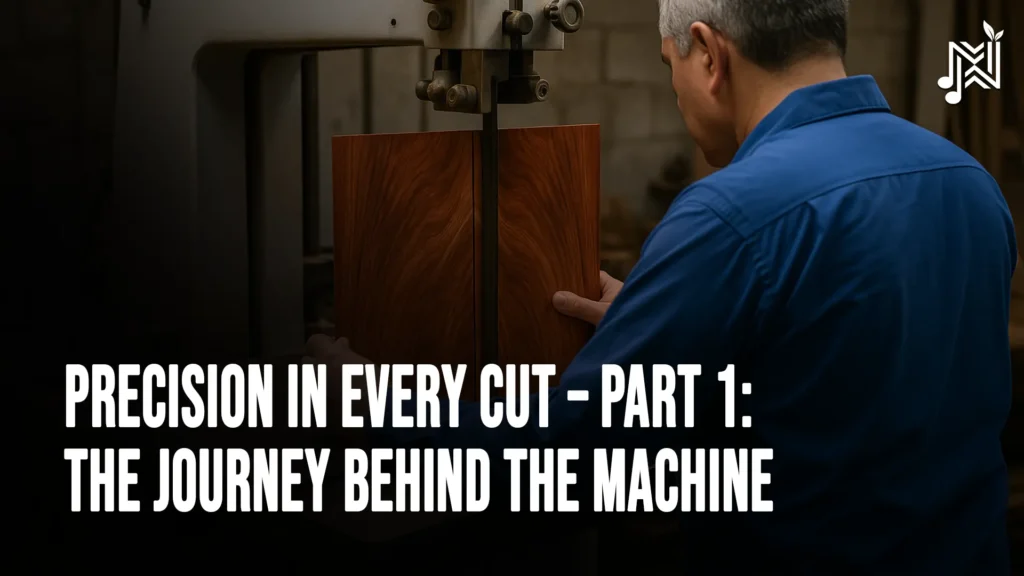
Introduction: The Long Road to Precision
Every craftsman has that one problem that keeps coming back no matter how many times you face it. For me, it was resawing. Cutting tonewood into perfect thin slices may sound simple in theory, but in practice it is a relentless challenge. Machines are not made with luthiers in mind. They are designed for volume, for speed, for lumberyards that sell two-by-fours, not for billets of rare Brazilian Rosewood destined to become world-class guitars.
So the journey began. A journey that cost thousands of dollars, countless hours, and more failed attempts than I care to remember. A journey that required experimenting, adapting, tearing things apart, and starting over again and again until something worked. The headaches were real. But in the end, the result was worth every ounce of effort: a resaw machine that cuts so smoothly, so consistently, that luthiers can see and hear the difference in an instant.
When a slice comes off this machine, the surface is clean, the thickness is even, and the figure is revealed in full detail. It is the kind of precision that saves hours of sanding and, more importantly, preserves the integrity of woods that may never be available again.
What Luthiers Notice First
Builders who visit the shop often pause after the first cut. They run their hands across the surface, tilt the board against the light, and say the same thing: “That’s beautiful.” Not because of me, but because the machine lets the wood speak for itself. The cut reveals grain and flame that would otherwise be dulled by vibration or torn fibers.
This is not just about aesthetics. A clean cut preserves yield. With rare tonewoods, every millimeter matters. A smoother cut means less sanding, less loss, and more sets produced from a single billet. It is not just efficient, it is respectful.
A Shop That Attracts the Greats
One of the most unexpected rewards of perfecting this machine has been the people it has brought into our shop. Over the years, world-renowned luthiers and guitar makers have stopped by, each bringing their own stories, billets, and expectations.
Richard Hoover, founder of Santa Cruz Guitar Company, is one of our most frequent visitors. Richard has a keen eye for wood and decades of experience. Yet he often chooses to bring his billets here to be resawn, because he trusts what the machine delivers. That trust is one of the highest compliments we could ever receive.
And Richard is not alone. We have hosted Ricky Barlow, Leo Buendia, Michi Matsuda, Stephen Strahm, Kevin Kopp, and many others. Each has their own approach, their own philosophies of guitar building, but all share the same appreciation when they see the results of a clean, precise resaw. They understand how much of their craft depends on wood that has been prepared with care.
The First Impressions
There is something electric about watching a billet of Cocobolo, Ebony, or Mahogany get sliced open, revealing figure that has been hidden for decades. Visitors are often surprised at how little sanding is needed to bring the surface to finishing quality. They can immediately see how this saves them time and money, but more importantly, they see how it safeguards their investment in tonewood.
I have watched faces light up when a board of Honduran Rosewood or African Blackwood passes across the blade and comes out flawless. No chatter marks, no wasted thickness, no compromises. Just clean, beautiful wood, ready to sing.
Why This Story Matters
Part of the reason I share this journey is because it is not just about me or my shop, it is about the community of luthiers who depend on wood being handled with respect. The truth is, there are not many places left where you can walk in with Brazilian Rosewood billets and know they will be resawn with both precision and reverence.
This machine is not the end of the journey, it is the beginning. It opened the door for collaborations, for friendships, for projects that would not have been possible otherwise. And that is why I say: the cut itself is beautiful, but the connections it has created are just as meaningful.
Looking Ahead
This is only the beginning of the story. In the next part, we will explore in detail what makes resawing so challenging, the hidden technical battles that determine whether a cut succeeds or fails, and how years of problem-solving led to the solutions we use today.
Because precision is not an accident. It is the result of persistence, of understanding, and of never giving up until the machine and the wood finally cooperate.
Get in Touch
📍 Marvel Woods – Morgan Hill, California
📞 Phone: 408-900-9999
📧 Email: support@marvelwoods.com
