


Introduction: From “Why Drying Matters” to “How We Do It”
In Part 1, we explored why drying is the unseen foundation of stability and tone. We discussed how water, if left unmanaged, becomes the source of cracks, twists, and instability that frustrate builders. We acknowledged the truth that wood will always carry its nature—but that careful drying can give it the best chance at long-term balance.
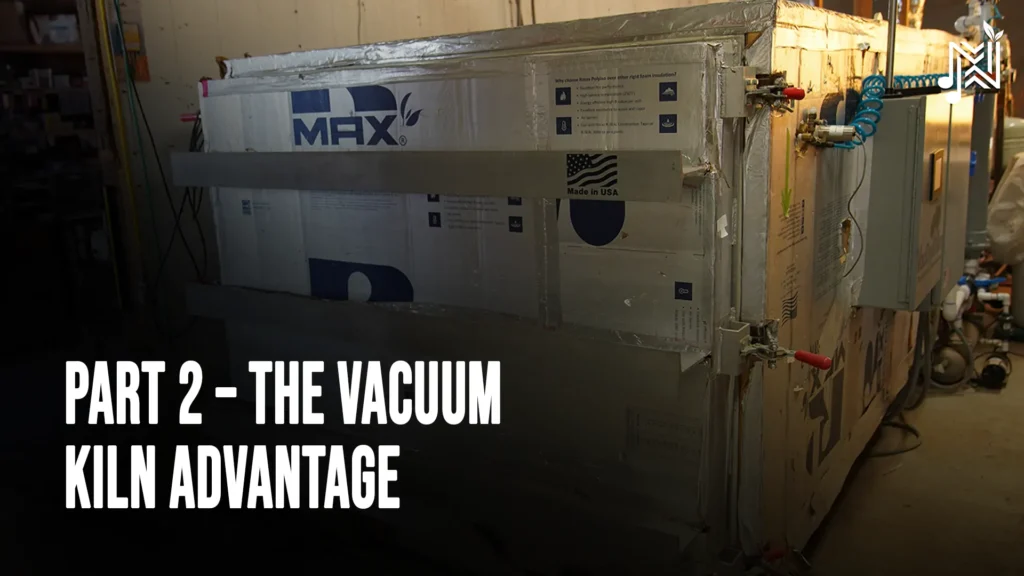
Now, in Part 2, we turn to the heart of Marvel Woods’ approach: our vacuum kiln. This system is not a shortcut, not a replacement for patience, and not a piece of generic lumber equipment. It is a carefully designed environment, built to respect the individuality of tonewoods while preparing them for the demands of fine lutherie.
We consider it the finest technology available for this purpose. Here’s why.
The Science: Why Lower Pressure Changes Everything
At sea level, water boils at 212°F. Conventional kilns use this principle by heating wood until water evaporates. But heat comes at a cost. Above 150°F, wood begins to undergo chemical and structural changes. Oils shift, resins soften, and cells weaken. For flooring, this may not matter. For tonewoods, it does.
A vacuum kiln changes the equation. By lowering atmospheric pressure, the boiling point of water is reduced to just 91°Farticle5_pt2. That shift is dramatic. It means moisture can leave without subjecting the wood to damaging heat.
Think about it: Honduran Rosewood, dense and oily, retains its rich tap tone when moisture is coaxed out gently. Cocobolo, notorious for its resin content, dries evenly instead of bleeding unpredictably. Black and White Ebony, among the densest woods on earth, releases water slowly without collapsing its structure. Camphor Burl, visually dramatic but structurally fragile, holds its figure instead of checking. Even Honduran Mahogany, historically more forgiving, benefits from drying that preserves its warmth and stability without stress.
In short: lower pressure protects the very qualities that make each species valuable to luthiers.
The Rhythm of Drying: Pressure Cycles
Drying is not just about temperature. It is about how moisture moves. Left unchecked, the surface of a board may dry faster than its core. That imbalance creates internal stress. In conventional kilns, this stress often remains hidden until the builder starts cutting.
Our vacuum kiln addresses this through controlled cycles of pressure, a process known as hysteresis. During low-pressure phases, moisture is encouraged to migrate outward. During recovery phases, pressure is increased slightly, allowing the wood to “rest” and equalize. The cycles continue, guiding water out steadily.
This rhythm is what prevents case-hardening. It is why a Honduran Mahogany neck blank cut from our stock stays straight on the bench. It is why Cocobolo sides bend with predictability instead of snapping under hidden stress. It is why an Ebony fingerboard remains stable under fret installation, resisting cracks that plague poorly prepared boards.
Adaptability: Different Species, Different Needs
One of the greatest strengths of our system is adaptability. No two species dry the same way. Some release moisture willingly; others resist. Some are fragile under stress; others are resilient. Our kiln allows us to adjust cycles, times, and temperatures to suit each species.
- Honduran Rosewood dries to equilibrium without losing its clarity. Boards that might have checked under conventional drying retain their bell-like resonance.
- Mexican Cocobolo, dense and oily, is given slower cycles to prevent resin bleed, preserving both tone and color.
- Black and White Ebony, with its striking contrast of cream and black, is dried gently to prevent cracking between grain lines.
- Camphor Burl demands careful balance: its swirling figure is stabilized without collapse, so its visual drama is preserved.
- Honduran Mahogany—once air-dried by tradition—emerges more consistent, its warmth intact, its workability enhanced.
This species-specific tailoring is what makes our process unique. We do not treat all boards the same; we respect their differences and prepare them accordingly.
Why We Made the Investment
Acquiring this kiln was neither easy nor cheap. It required significant resources and a willingness to take a long-term view. But for Marvel Woods, the decision was simple. Luthiers deserve wood that is more than beautiful—they deserve wood that is reliable.
We had seen too many stories of instability: a Rosewood back that split after bending, a Mahogany neck that twisted in a drier climate, a Cocobolo board that oozed resin during finishing. These issues are not signs of poor craftsmanship. They are signs of poor preparation.
By investing in precision drying, we chose to take responsibility for that preparation. We chose to make drying a point of pride, not an afterthought. For us, the kiln is more than equipment—it is a promise to our clients.
What This Means for Builders
The practical benefits for luthiers are clear:
- Predictability in the shop: Blanks cut cleanly, sides bend smoothly, joints stay tight.
- Stability across climates: Instruments built in California play just as well in Arizona or New York.
- Tone that inspires: Builders consistently describe our wood as “alive,” with tap tones that ring instead of thud.
And perhaps most importantly: trust. Builders can invest hundreds of hours into a guitar without fear that the material will betray them months later. For those offering lifetime warranties, this trust is not optional—it is essential.
Respecting Wood’s Nature
It is important to be clear: our kiln does not make wood perfect. Honduran Rosewood will always have its density. Cocobolo will always be resinous. Black and White Ebony will always carry the risk of fine checking. Burl woods will always be delicate. Mahogany will always be lighter and warmer than its cousins.
What we provide is not control over nature, but guidance. We give each species the preparation it needs to perform at its best. We reduce the risks luthiers cannot afford, while respecting the individuality that makes each species valuable.
Conclusion: The Technology Behind Trust
The Marvel Woods vacuum kiln is more than machinery—it is philosophy in action. By lowering pressure to reduce boiling temperature, by cycling pressure to release moisture evenly, and by adapting to each species, we prepare tonewoods with a level of precision not readily available elsewhere.
Wood will always move, always adapt, always surprise us. But when luthiers start with Marvel Woods, they know their material has been given the best possible chance at stability and tonal excellence.
In Part 3 of this series, we will go deeper into the science. We’ll explore free water and bound water, why removing bound water is the hardest challenge in drying, and how our kiln manages it without damaging the structure that gives tonewoods their voice.
For now, it is enough to say this: drying is not just about hitting a number on a moisture meter. It is about respecting the individuality of Honduran Rosewood, Cocobolo, Ebony, Burl, and Mahogany—and preparing them for the artistry of the luthier.
Get in Touch
Looking for properly prepared tonewoods or kiln-drying expertise you can count on? Marvel Woods is here to help. We supply luthiers with wood that’s been given the best chance at stability and tone.
📍 Marvel Woods – Morgan Hill, California
📞 Phone: 408-900-9999
📧 Email: support@marvelwoods.com
